
Throuple or V? Discover Which Poly Dating Fits You Best
Choose a Throuple when all three people share romantic interest and want to build relationships with one another. Choose a V when one person dates two partners who do not share a romantic relationship. The right choice reflects the connections that already exist and the commitments each person can maintain.
Three people may enjoy being together even when attraction develops between only two of them. In another situation, all three pairings may feel promising, yet one person has little influence over shared decisions. Examining how the relationships work gives everyone a clearer starting point than selecting a label in advance.
How Throuple and V Relationships Work in Poly Dating
A Throuple contains three individual romantic relationships within one group. If Partner A, Partner B, and Partner C form a Throuple, every person has a relationship with the other two. The trio may also develop a shared identity, though each pairing still needs room to communicate in its own way.
A V contains two romantic relationships connected through one person, commonly called the hinge. The hinge’s two partners are metamours. They may become friends or keep their contact limited. Their connection does not need to become romantic for the structure to work.
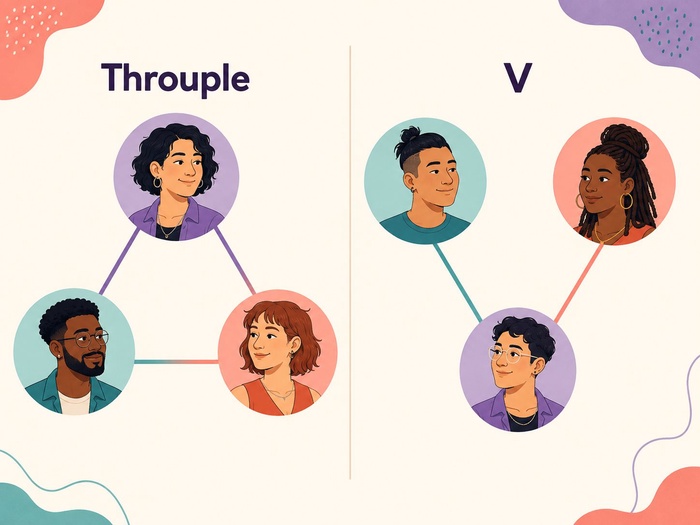 These terms describe how people are connected. The people involved still decide what commitment means and how closely they want their lives to overlap.
What Makes a Throuple Different From a V Relationship?
The practical difference appears when a decision or conflict reaches more than one relationship. In a Throuple, a disagreement between two partners can draw in the third. That person may feel expected to mediate or take a side. Healthy pairings remain responsible for addressing their own problems.
A V places more responsibility on the hinge. The hinge must keep agreements with two partners without using one relationship to manage the other. Comparing partners, sharing private messages, or asking one metamour to calm the other can damage trust on both sides.
Power also deserves attention when an established couple begins dating someone new. The couple may already share a home, finances, or years of history. A newer partner will notice if every important choice has already been made. Decisions that affect the whole group should include everyone who will live with the result.
What Throuple and V Relationships Ask of Your Time and Trust
Available time often determines whether an appealing relationship structure can work in daily life. A Throuple must support the three individual pairings as well as the connection shared by the group. If every meeting includes all three people, one pairing may never develop enough independence.
The hinge in a V faces a different limit. Two partners may each expect regular contact, while the hinge still has responsibilities outside those relationships. A realistic schedule provides more security than a promise of constant availability.
Each person can explain how often they are able to meet and how much notice they need when plans change. This gives everyone information they can use before a scheduling limit is mistaken for rejection.
Trust also depends on knowing what remains private. A change that affects a shared agreement should be communicated. A personal conversation can stay within the relationship where it occurred. This distinction allows partners to be open without giving everyone unrestricted access to private details.
Throuple or V? Which Dynamic Supports Your Emotional Needs?
A Throuple may suit someone who enjoys shared closeness and wants an individual relationship with each partner. That person still needs to accept that affection may develop at different speeds. One pairing may communicate easily while another needs more time to feel secure.
A V may feel more comfortable for someone who values separation between relationships. With that, partners can choose the level of contact that works for them instead of performing closeness for the hinge’s benefit.
Specific discomfort can reveal what needs attention. Feeling overlooked during a group conversation may point to unequal participation. Anxiety before a partner’s date may come from an unclear agreement. Repeated pressure to settle other people’s disagreements can show that one person has accepted responsibility for conflicts that belong elsewhere.
Jealousy does not automatically mean the structure is wrong. It becomes easier to address once the person experiencing it can identify the behavior or expectation behind it.
Why the Right Poly Dating Community Makes a Difference
People often use the same relationship label for different expectations. Someone hoping to build a committed three-person relationship may meet a couple interested in a casual experience. A person interested in a V may welcome occasional contact with a metamour while preferring to date independently.
A community that welcomes different relationship structures makes these expectations easier to discuss before anyone becomes emotionally invested. A useful profile explains whether the account belongs to one person or a couple and whether existing partners date together or separately.
That clarity gives potential matches something concrete to consider. A single person can avoid entering a relationship that offers little personal choice. A couple can show how a new partner would participate rather than asking that person to fit into decisions already made.
Why BiCupid Stands Out for Polyamorous Dating
BiCupid brings bisexual singles, couples, and open-minded members into one dating community. Members can meet people who are already comfortable discussing attraction across genders and connections involving more than two partners. Early conversations can focus on compatibility instead of explaining every term from the beginning.
Verified Members can add confidence during the introduction stage, while Privacy Controls allow account holders to manage their visibility. These features help members begin contact at a pace that feels comfortable. Trust then develops through honest communication and consistent behavior.
How BiCupid Helps Poly Daters Find Like-Minded Connections
Members can begin with a small sign of interest and move into conversation when both sides are ready. Voice messages can make tone easier to understand, while short videos provide another way to show personality. The aim is to make an introduction feel more natural without turning it into an immediate negotiation about the future.
Once a conversation begins, specific descriptions are more useful than broad promises. A couple might explain that each partner builds individual connections. A single person might say that meeting a metamour feels comfortable, although the romances should remain independent.
These details show how someone expects to behave when an actual relationship develops. They also expose incompatibility before anyone makes commitments based on an attractive but vague profile.
Which Poly Relationship Fits Your Dating Life Best?
Look first at whether every romantic connection can stand on its own. In a possible Throuple, each pair should be able to communicate without depending on the third person to keep the interaction comfortable. When romantic interest runs through one person, a V describes the situation more accurately.
Next, notice how much choice each person retains. Nobody should have to date both members of a couple to continue seeing one of them. Metamours should also be free to decide how involved they want to become in each other’s lives.
Consider what would happen if one relationship changed. A pairing may develop slowly or eventually end. The remaining relationships need to be evaluated on their own instead of being sacrificed automatically to preserve the original structure.
Let the label describe what develops. It should not assign feelings or obligations before the people involved have chosen them.
Build a Consensual Throuple or V Relationship at Your Own Pace
Begin with a commitment that everyone understands and can keep. Make one plan, observe how each person communicates, and allow trust to grow before making larger promises.
Partners should decide how health information will be handled and which conversations remain private. Anyone must be able to decline a plan or revisit an agreement without risking every connection in the group. Responses to those moments show whether the relationship can adapt when circumstances change.
BiCupid can help you meet bisexual singles, couples, and poly daters who are ready to discuss the relationships they hope to build. Start with an honest profile and one thoughtful conversation. If interest develops, the next step can follow at a pace that works for everyone involved. Join BiCupid and begin meeting compatible people.